Wild
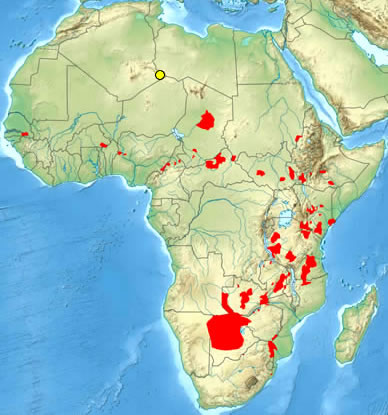
dogs were once widely distributed throughout Sub-Saharan Africa.
Today viable populations exist
in only a few countries (as shown in red above; the yellow
circle towards the top indicates probably existing).
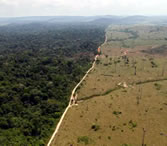
Habitat fragmentation and encroachment, persecution (conflict
with livestock and game farmers), accidental deaths by snares
set for game, speeding vehicles, and infectious diseases (rabies
and distemper) are the main causes for their decline.
The
needs of a growing
human population place ever-increasing pressure on finite
natural resources, shrinking the living space not only for wild
dogs, but other wildlife, making conflict inevitable, and contributing
to biodiversity loss. Biodiversity loss is also exacerbated by
climate change. These
two interrelated problems threaten life on Earth. Overconsumption
is another major threat. It has been estimated that we are currently
overusing our planet's natural resources by at least 75% or the
equivalent of living off 1.75 Earths. In the past half century,
the average size of wildlife populations has fallen dramatically
by
73%.
|
|
Taxonomy
|
Order: |
Carnivora |
| Family:
|
Canidae |
| Genus/Species: |
Lycaon
pictus |
| Description |
Coloration: |
mottled
coat of yellow, black, white, and brown |
| Head
and Body Length: |
76
to 123 cm |
| Weight: |
17
to 36 kg, avg. 25 kg |
| Shoulder
Height: |
61
to 78 cm |
| Miscellaneous: |
longitudinal
black mark on forehead; large, round ears; bushy, white-tipped
tail |
| Reproduction |
Time
of Mating |
in
southern African usually around June, more variable in East
Africa |
| Gestation
Length: |
69
to 72 days |
| Litter
Sizes: |
avg.
approx. 8 |
| Age
of Sexual Maturity: |
1
year, but usually sexual suppression results in later age
of reproduction |
| Home
Range |
Size
and Movement: |
423
to 1318 km²; except when denning, packs are nomadic,
covering large areas; many live in unprotected areas or
range outside park boundaries |
| Habitat |
woodland
and dense bush to open plains |
|
| African
wild dogs are not feral domestic dogs nor closely related to wolves.
Learn more about their evolutionary
history and adaptations along with nine other members of the
canid family on a
phylogenetic tree.
|
|
|
|
|
| |